
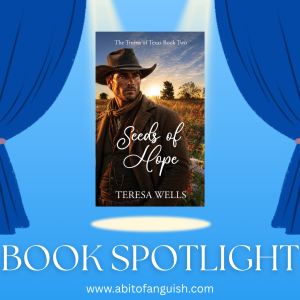
Teresa Wells has become a great friend to me over the last few years. And since I’ve been blessed to be her content editor on her first two books, I can honestly recommend both of them. There’s something about Teresa’s stories that speaks to my heart–the first including sewing and the second gardening. I love both and she weave them in beautifully. Read to the end and see if she doesn’t intrigue you, too, with what she learned in her research for Seed of Hope.
As a historical romance writer, I research all the time. Often, I trip over factual tidbits that pique my curiosity. I tuck those little-known truths away for further investigation. Sometimes I even include them in my books.
And occasionally, those morsels transform from hidden gems to historical plot line. In my first novel, the gem was crazy quilts. In Seeds of Hope, the gold nugget from the past was the School Garden Movement.
I’d never heard of the School Garden Movement, even after teaching for twenty-five years. You’d think an educational crusade that spanned oceans and continents would be discussed by today’s scholars. We’ve all heard of McGuffey Readers, slates, and one-room schoolhouses. But school gardens? Not so much.
That’s why it was perfect for Sallie Parker, my female lead in Seeds of Hope. But to portray it accurately, I had to learn the ins and outs of the educational practice for myself. I was especially intimidated by anything garden-ish, being a notorious chicken when it comes to bees, snakes, and worms.
Thankfully, research and an editor who loves her garden kept me on the right path (thanks, Amy!).
So what did I learn about the School Garden Movement?
It was a philosophy that originated in Europe in the mid-1800s, suggesting that schools assign a tiny plot of land to each student to provide firsthand experience with nature, beyond textbook knowledge. Specifically, if students planted seeds and cared for plant life, they would be more interested in the anatomy of a plant, its life cycle, and the benefit it brought to humans.
As the idea caught on and crossed the ocean to American schools, educators noticed more advantages to school gardens. Students who worked with plants became more focused on all living things in nature, such as birds, insects, etc. Late nineteenth century society believed that beautiful surroundings encouraged good health. School gardens cultivated powerful observations of the world outside the school buildings, resulting in appreciation of colors, design, and habits. Souls were refreshed to see beautiful flower gardens. In an article in the Waco Times-Herald in 1898, J. W. Barnett, the president of the Texas State Floral society, asserted that students “find something to take care of, something to quickly respond to love’s labor, and as interest is added to interest, they lay up for themselves resources for happiness which should be the heritage of every child …”
Of course, there were the more practical benefits of school gardens, such as encouraging interest in farming and handling the soil, trees, and plants with greater skill and knowledge. But for me, the most profound outcome of the school garden movement took place with a part of society that is often overlooked: the poor. Impoverished students took home the vegetables they grew at school, along with the knowledge and skills to plant their own home garden. Students learned to raise the food their parents couldn’t afford to buy.
School gardens brought hope to the hopeless, and food to the hungry.
This was the gold nugget I’d been searching for. I had planned on Sallie’s school being in a transient village just outside town. But something was missing. I felt the Lord urging me to discover Sallie’s true purpose as the garden teacher. And there it was, rising up from the brittle pages of antique research documents. Sallie’s purpose was to teach needy children to survive by growing their own food. Her purpose became the heartbeat of Seeds of Hope.
Sometimes the past hides the greatest treasures. It’s deeply satisfying when those treasures are brought into the light again through the wonder of fiction.
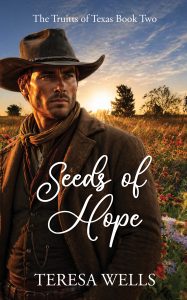
Blooming Grove, Texas, 1896
Deputy Rabb Truitt has sworn to protect Blooming Grove. But when a clerical error sets a criminal free, Rabb blames himself. He should’ve admitted he can’t read, and now he must resign. If he failed the town once, he could fail it again.
A recent survivor of a devastating fire, Sallie Parker refuses to let Rabb give up the job he loves. She helps him make sense of letters on the page, and as his knowledge grows, so do their feelings for each other.
When a series of mysterious events surround Sallie’s school, Rabb fears a connection to cattle rustlers he’s pursuing. Each day without arrest, the demands for mob justice increase. Rabb races to protect the town and the woman he loves. But is he too late?
 Award-winning author Teresa Wells writes stories threaded with hope and redemption. She loves meeting people, touring old homes, and studying the Bible. She lives with her husband of 45 years outside of Dallas, Texas. Her debut novel, What Brings Us Joy (Scrivenings Press, 2025), is a double winner for the 2026 Holt Medallion Award and took first place in the National Excellence in Storytelling contest. Seeds of Hope, Book 2 in The Truitts of Texas series, released in July of 2026. You can find Teresa on FaceBook, Instagram, and online at teresawells.com.
Thanks so much for your kind words, Amy, and for spotlighting Seeds of Hope! I couldn’t have done this without you!
You’re very welcome!